热门资讯> 正文
收益率曲线倒置后:降低风险并多元化
2019-08-19 15:42
Funds are ranked using Mutual Fund Observer for risk, risk-adjusted returns, price trends, P/E ratio, bond quality, discount premium (Morningstar) for closed end funds, leverage, category performance during recessions.
Reasons to be concerned about a recession in 2020 or 2021 are described.
Recession-resistant funds are listed for Vanguard, Fidelity, Closed End Funds, and Exchange Traded Funds.
Chart #1 shows that the 10 year Treasury rate has fallen 50% in the past 10 months and 25% in the past 2 weeks as investors seek safety. Intermediate bond funds have done well. The Fed is likely to continue lowering the Fed Funds Rate impacting the short end of the yield curve while steepening the yield curve. How will this impact investment opportunities going forward?
Chart #1: 10-Year Treasury Rate and 10-Year-3 Year Yield Curve
Table #1 shows some representative top-performing bond funds during the 2000 Bear Market (Sep. 2000 to Sep. 2002) and 2007 Bear Market (Nov. 2007 to Feb. 2009). Intermediate Treasuries out-performed short term Treasuries. What about continued global easy money, high deficits, corporate leverage, Brexit, Iran, North Korea, trade wars...? Lions and tigers and bears, oh my!
Ulcer Index (Risk) is a measure of length and duration of a draw-down. Martin Ratio (risk-adjusted return) the risk-free return divided by the Ulcer Index. They are for the past 18 months.
Table #1: Top-Performing Bond Funds During Bear Markets
In June, I wrote "Funds That Do Well When The Yield Curve Is Inverting" which looked at how representative funds did during the time when the yield curve was inverted. The returns by Lipper Category are summarized for the two time periods when the yield curve was inverted and the periods when the Federal Funds Rate was falling. And here we are again in 2019, deja vu all over again. The yield curve is inverted and the Federal Reserve cut interest rates. I hear chants of "This Time is Different" that the yield curve does not mean a recession is going to happen, as I also hear that there are $15T in negative-yielding bonds around the world, highly leveraged corporations, and the 30-year treasury is now below 2%. The S&P 500 fell 3% last Wednesday as investors reacted sharply to the brief inversion of the 2- and 10-year treasury yields.
The article was limited in that it was based on 88 representative funds that covered both time periods. Mutual Fund Observer has been modified so that we can look at more funds by year and market cycles. With interest rates falling on the short end, is it time to move to short-term bonds? With a recession possible starting in late 2020 or 2021 should we be moving into lower yielding, quality bonds or chase yield? A look at Table #2 shows that short-term bond funds did better than slightly intermediate bond funds during the time periods shown below. What about now?
Table #2: Returns During Yield Curve Inversions and Falling Fed Fund Rates
What if we have a soft landing instead of recession? I think it is prudent to plan on current conditions with an eye on the long term. Secondly, each recession is different, caused by different factors. Perhaps a better question is, "How severe will the next recession be?"
There are valid concerns about recessions and the impact on portfolios. Gold is a viable option in times of uncertainty. During the 2007 Bear Market, IAU rose 13%, and has been climbing lately. Gold has a negative correlation to the S&P 500 as do long-term bonds. It may help reduce the volatility in a bear market.
Table #3: Gold
What I like about Mutual Fund Observer is that you can screen thousands of funds into hundreds using risk (Ulcer Index, Draw-Down), Risk-Adjusted Return (Sortio), annualized percent return, yield, and Fund Family Rating, among many others. MFO just got better in that it now has historical information by month, year and market cycles in the data download.
Still, each individual investor has different desires and the data-driven investor can set up his own criteria to rank funds using Excel. I used risk (Ulcer Index, Draw-Down), risk-adjusted returns (Martin Ratio), valuation (P/E Ratio from MFO and Premium/Discount from Morningstar), 3- and 10-month price trends, bond quality, leverage, yield, average category performance during recessions, upside and downside capture, and annualized percent return.
Table #4 contains the top-ranked Objectives. I used Objective because there are fewer of them than in the Lipper Categories. The Ranking System is intended to select funds that are doing well now and may do well during a recession and this is a trade-off which requires some further consideration beyond the ranking system. Each of the Fund Objectives has had a low Ulcer Index (Risk of draw-down) during the past 18 months, and losses were limited during the past two bear markets. Here are a few observations about the categories:
Emerging Market Local Currency Debt: This category is based only on the Vanguard Emerging Markets Bond Fund (VEMBX).
General & Insured Municipal Debt (Leveraged)
: This category contains mostly closed end funds, and it can be seen that during the financial crisis they did not do well. It is not a category that I am interested in owning during a recession. The same appears to be true for General Bond.
High Yield Municipal Debt:
This category is lower risk than its corporate counterpart as shown in the Bear Market Returns.
Real Estate
: This Objective has been a high performer this past year. The 2007 Bear Market started with a housing bubble, and sub-par loans which transformed into a financial crisis.
Utilities
: This category has become more expensive and has not done well in the past two recessions.
Income and Preferred Stock Funds
: This Objective has high yields and moderate losses during Bear Markets.
Longer duration Treasuries tend to out-perform shorter term funds during downturns.
To summarize, I built the Ranking System to reflect a preference for modest valuations, higher quality, low leverage, low risk, higher yields, and higher risk-adjusted returns with an eye on a possible recession in late 2020 or 2021. The key takeaway is that each of the Objectives in Table #4 is likely to out-perform most equity categories during the next recession. I use Benjamin Graham's guideline of always having at least 25% in equities, but these can be invested in lower risk equity funds such as in real estate, low volatility funds, equity income, and preferred securities. This article focuses on bonds. Equity Funds are described in Enhanced, Managed, Index And Great Owl Funds.
Table #4: Objectives Performance Now and in Bear Markets
The Federal Reserve Bank of New York produced the following chart estimating the probability of a recession to be about 30% using the yield curve. I believe that a 30% probability of a recession starting in the next 12 months is realistic and this section looks at supporting evidence.
Chart #2: Twelve-Month Recession Probability
The Third Quarter 2019 Survey of Professional Forecasters by the Federal Reserve Bank of Philadelphia estimates the probability of a quarter of negative growth to be 26% by the third quarter of 2020.
Table #5: Twelve-Month Risk of Negative Quarter
Below is a chart that I maintain of the percent of the yield curve that is inverted compared to the Chauvet Probability recession model. The yield curve is a long leading indicator of recessions and other indicators may take 6 to 12 months to start showing whether a recession is likely.
Chart #3: Yield Curve vs. Recession Probability
I built a recession indicator (green) based upon 16 composite indicators, one of which is the yield curve, to give advance warning of recessions. It is showing a 19 percent chance of a recession. The weakness is broad and expanding. The grey shaded areas are the OECD recession indicator which is a good indication of a soft economy, but gives false warnings of recessions. The GDP Recession Indicator (brown) had its last data point for the first quarter and is now six months behind. The Chauvet Probability Model is good, but does not give much advance warning.
Chart #4: Author's Recession Probability
The next few indicators show that the weakness in the financial markets and economy can be seen in daily, weekly, monthly and quarterly data.
Daily Data
Of the daily indicators, the Moving Average Convergence Divergence is a short-term momentum indicator which shows that the S&P 500 lost steam in mid-July.
Chart #5: Daily Technical Indicator (MACD)
The inverting yield curve (red) is accompanied by higher volatility (blue). The spread demanded for high yield bonds is increasing (purple), which is often accompanied by higher expectations of a recession.
Chart #6: Daily High Yield Spread
Weekly Data
While still low, the St. Louis Reserve Financial Stress Indicator is starting to rise.
Chart #7: Weekly Financial Stress
Monthly Data
Leading Indicators like the Philadelphia Fed's USSLIND or Conference Board's LEI have been declining or flattening for the past year.
Chart #8: Monthly Leading Indicators
Chart #9 is important because falling orders usually lead to falling sales. Durable Goods orders have fallen lower than a year ago. Capital Goods Orders are near contraction. However, in 2015 this was not followed by a recession.
Chart #9: Orders (YOY)
Institutional (Smart Money) and Retail Investors (Dumb Money) have both been building up cash reserves for the past two years.
Chart #10: Monthly Money Funds
Quarterly Data
Corporate profits have been fairly anemic for the past six years and are starting to decline.
Chart #11: Quarterly Profits
Even with share buybacks, sales and earnings per share have been declining or flattening for the past year. Since about 40% of the sales of the S&P 500 come from overseas, the slowing global economy will continue to impact US corporations.
Chart #12: Quarterly Earnings and Sales Per Share
Past 18 Months
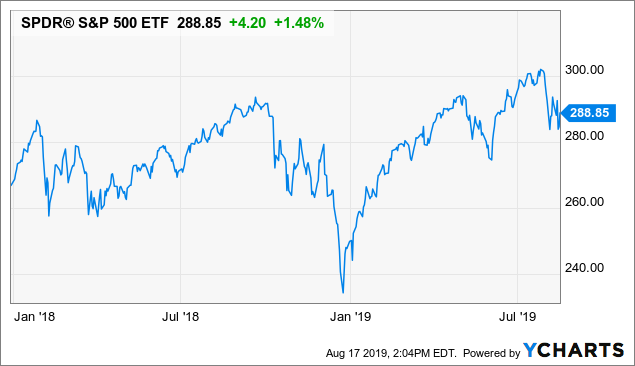
Chart #13 shows the S&P 500 since January of last year as investors started retrenching adjusting portfolios for a late business cycle stage. The next 18 months are likely to be as volatile or more than the past 18 months, in my opinion.
Chart #13: S&P 500 Price Performance
 Data by YCharts
Now that we have an overview of what funds do well in a recession and that the probability of recession, while still moderate, is increasing, let's look at specific funds to build a portfolio to weather a recession. I selected 10 highly ranked funds from Vanguard, Fidelity, Exchange Traded Funds, Closed End Funds, and "other" mutual funds.
Vanguard
All of the Vanguard Funds are solid investments for small investors such as myself. The Emerging Market Bond and Long Term Treasury Funds will be more volatile. The Municipal Bond funds will be a good fit for after tax accounts. I profiled the Vanguard Emerging Markets Bond Fund (VEMBX), which I own, in Low-Risk Funds: The Short List.
Table #6: Top Ranked Vanguard Funds
Fidelity
Fidelity has more funds to select from than Vanguard, which may be intimidating for small investors. Below are solid recession-resistant funds to choose from. The Focused High Income and Emerging Market Debt will be more volatile. I like the Real Estate Income Fund (FRIFX) which did better than most real estate funds during the 2007 Housing Bubble/Financial Crisis.
Table #7: Top Ranked Fidelity Funds
Closed End Funds
Table #8 contains the top ranked closed end funds per Objective. The Premium/Discount is from Morningstar. Closed End Funds are generally attractive because of their high income. A good source for researching closed end funds is CEFConnect by Nuveen Closed End Funds. Closed End Funds require more research of management and distributions. I did a quick check and PGZ is paying a portion of distributions from "Return of Capital" as does MCR which raises the question of sustainability of distributions. The high draw-down of HPI during the financial crisis is not as major of a concern to me as is the premium. FPE is an exchange traded fund that may be an alternative.
Table #8: Top Ranked Closed End Funds
Exchange Traded Funds
The top ranked exchange traded funds exhibit low risk and high risk-adjusted performance for the past 18 months. Most of the top-performing exchange traded funds were not in existence during the 2007 Great Recession.
Table #9: Top Ranked Exchange Traded Funds
Other Mutual Funds
I track mutual funds other than Vanguard and Fidelity for interested readers who do not use these investment companies. However, I pre-screen them to include funds that can be purchased at Vanguard or Fidelity.
Table #10: Top Ranked Other Mutual Funds
I like to track various funds as baseline funds as shown in Table #11. The Vanguard Wellesley Income Fund (VWINX) is my target risk off fund to beat on a risk-adjusted basis. Vanguard LifeStrategy Income (VASIX) is another great risk-off fund. Note that other than an intermediate bond fund (BND), VWINX and VASIX have the highest 12-month returns. Returns for the past one and three months are among the highest. Both are core holdings in my portfolio.
Table #11: Baseline Funds
To continue to reduce risks and prepare for the next recession, high diversification into lower risk funds is prudent. The funds listed in this article are great starting points. Equities can still climb 10% while the yield curve has inverted, but the chances of a recession are rising. Buying low and selling high means being a contrarian. Shifting allocations to bonds over the past year was more risk management than market timing.
To answer some of the questions at the start of this article, I still favor intermediate quality bonds, but have a smaller, but substantial allocation to short duration bonds as well. I also favor municipal bonds and quality corporate bonds. Corporate Debt? What about high leverage? Corporate Debt Since The Great Recession, by Miguel Faria-e-Castro and Asha Bharadwaj at the St. Louis Federal Reserve describe the risks of leverage among difference types of corporate debt. There still is quality corporate debt, and that is my preference. I like the picture below from their article.
Being at the low end of my allocation to equities makes me a buyer of equities when the stock market does decline.
I am/we are long SWNTX, FPNIX, IAU, VEMBX, VTABX, VWINX, FHIFX, FLTMX, FTHRX, FMSFX, VASIX, VTINX, VWENX.
I wrote this article myself, and it expresses my own opinions. I am not receiving compensation for it (other than from Seeking Alpha). I have no business relationship with any company whose stock is mentioned in this article.
Additional disclosure:
I am an engineer with an MBA nearing retirement and not an economist nor an investment professional. The information provided is for educational purposes and should not be considered as advice. Investors should do their due diligence research and/or use an investment professional. I am employed in the precious metals industry.
推荐文章
美股机会日报 | 止跌企稳!纳指期货盘前涨约0.5%,有分析称美股连遭重挫后或回升;亚马逊盘前大跌超8%

一周财经日历 | 事关降息!美国1月非农、CPI数据下周公布;恒指季检结果下周五揭晓
华尔街大多头漫谈黄金“黑天鹅”风险:马斯克实现太空采金,化身全球央行行长
避险情绪席卷市场 华尔街青睐的热门交易纷纷崩跌
华盛早报 | 无一幸免!美股、金银、加密货币与原油集体崩盘;南向资金爆买250亿港元!创约半年来新高;千问APP今日启动30亿免单
亚马逊股价盘后大跌近10%,巨额资本支出引发担忧
比特币暴跌带来124亿美元巨亏 Saylor的金融实验岌岌可危
2月6日外盘头条:比特币暴跌 亚马逊预计今年资本支出将达2000亿美元 交易员料美联储将比预期更早降息